Camp J

I was 30 years old the first time I visited Angola Prison—once a plantation named after the African country that supplied its enslaved labor. That day, Angola held more inmates per capita than anywhere on earth. My colleague Kristen was just 22. We went there to cover the Angola Rodeo—30 years ago next month.
I remember feeling nervous as an armed guard patted his rifle and assured us we were in the “safest place in the world.” After passing through maximum security, we joined inmates preparing for the rodeo. Kristen told one inmate how the manicured landscape reminded her of the German countryside. He replied without hesitation, “Yeah, that’s what Hansel and Gretel thought.” I swallowed hard.
While she interviewed some spectators, I found a spot above the bull pens, where Johnny, nicknamed the “God of the Rodeo,” was calmly putting on his stirrups, focusing on the bucking bull he was about to ride. Not wanting to break his concentration, I turned to the next man in line and asked how long he’d been riding bulls.
“First ride,” he said, wearing a plain white T-shirt and denim.
“You’ve never ridden before?” I asked, surprised.
“What have I got to lose?” he said. “A few seconds of sunshine and freedom.”
Moments later, convict contestant #47 mounted the trembling one ton bull and made the sign of the cross. When the gate opened, the bull exploded into motion, twisting like a Category 5 hurricane. The crowd cheered. He clung on for a few seconds before being thrown into the air and crashing down. Rodeo clowns diverted the bull, narrowly saving him from tragedy.
I turned my camera to the crowd—families watching murderers and rapists risk their lives for sport. I saw a little blonde girl with a pink bow, happily eating cotton candy. Was she rooting for the bull or the inmate?
The crowd went wild during “Convict Poker,” where inmates sat still at a card table while a bull charged them. Last one seated in Iwon.
The men prayed before for the final and main event — “Guts N Glory.” The announcer’s voice crackled: “To those of you who are about to die, we salute you.” The crowd roared, then fell silent.
A Brahma bull was released into the arena, charging at a dozen men in white T-shirts. They dodged, fell, some launched into the air, others scrambled over the fence. After two minutes, convict #52 faced the bull, tense. He reached out and snatched a red chip between the bull’s eyes, drawing wild cheers from the crowd. No one died that day but one was transported away in an ambulance.
A year or so later, I returned to Angola and saw a less “festive” side. I was surprised to see men walk freely around the “Big House,” the main prison, like it was a little city, complete with a library, store, and gymn. I talked to a blue-eyed Italian man my age from Westwego, who assured me it was just a barroom brawl that went bad. We visited the Angolite, the award-winning newspaper, where I met a man who’d been imprisoned longer than I’d been alive. Still, I thought to myself, this prison isn’t so bad, not like the horror stories I had heard about “Alcatraz of the South.”
Reporter Allen Johnson and I then joined some inmates for lunch, where we ate salty mush with a spoon under guard’s watch. Then we watched inmates working the fields, monitored by rifle-wielding guards on horseback. I photographed prisoners digging graves—haunting reminders that many would never leave alive.
As we moved through the cell blocks, I heard the voice in my head: “Lock ’em up and throw away the key,” a refrain a had heard throughout my childhood in south Louisiana.
Finally, we were led into Camp J—the “dungeon” for unruly and dangerous prisoners. I remembered laughing at Harry Connick Jr. , who had been shackled there for a research project for a film, but cut it short after just one night.
The correctional officer called these inmates “the animals.” The silence in Camp J was eerie, a stark contrast to the busy “Big House” where men moved freely. Men in white jumpsuits were confined in tiny cells, with nothing but a metal toilet and a bed. I couldn’t bring myself to photograph their hollowed faces as we passed.
I stopped before a man sitting on his bed, wrapped in a blanket. Nervously, I lifted my Nikon F3 and took a shot. The shutter’s click echoed like a gunshot. The man threw off the blanket, his face contorted in rage. He lunged toward the exposed lightbulb, screaming he would kill me if I took another photo.
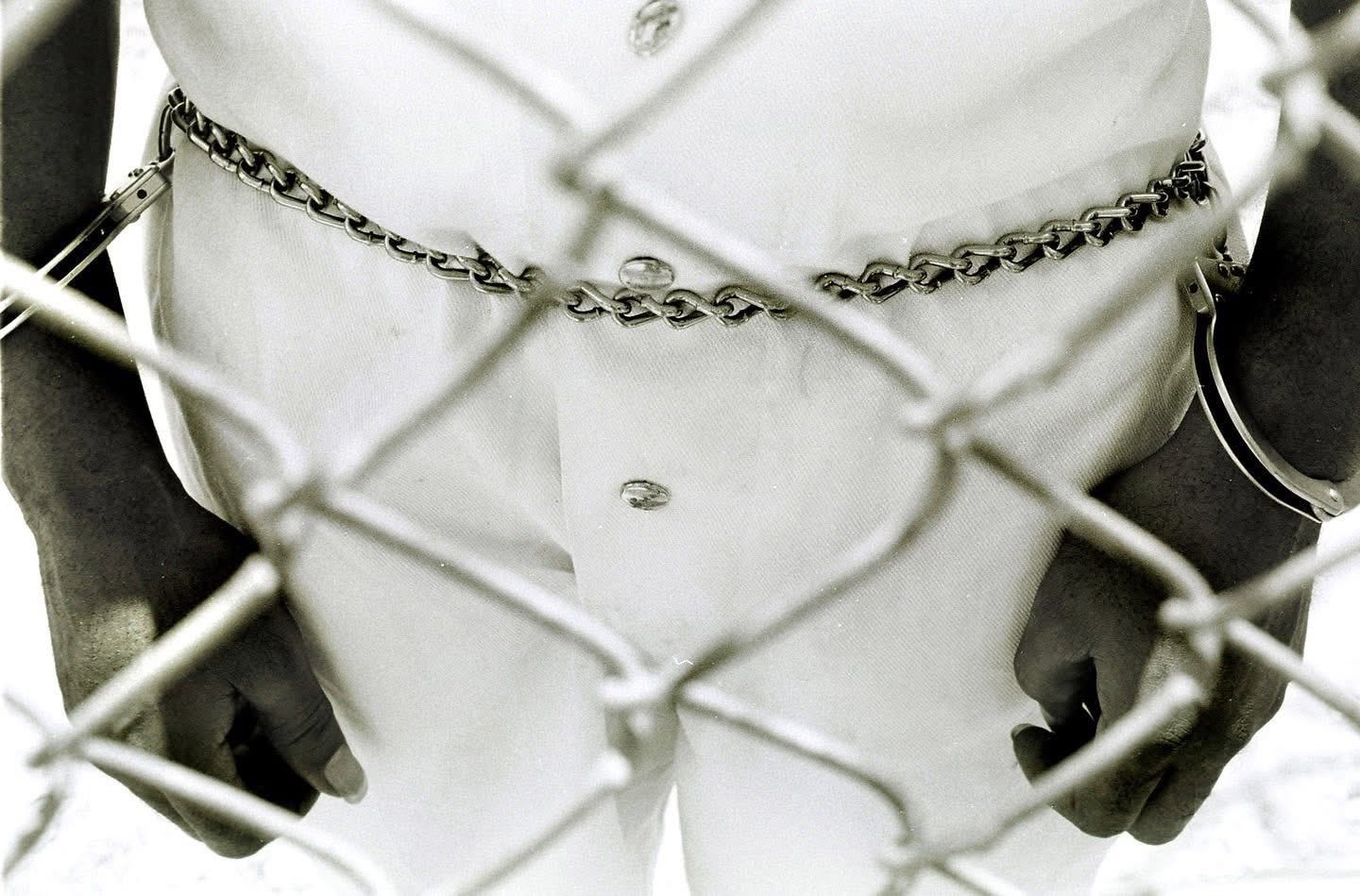
A corrections officer pulled me outside to the yard, where prisoners had 45 minutes of exercise. I saw a shackled man jogging in slow, deliberate steps—like a wind-up toy on an invisible track, or an animal in a cage. I hesitated to photograph him, trembling from the previous confrontation, but the guard told me it was okay. From behind his mirrored sunglasses, he sharply ordered the prisoner to stop and pose.
It was the first time I looked a murderer in the eye without the shield of my camera. I saw not a monster, but a deeply broken man, obviously mentally ill. Yes, he was a murderer, but I would never know the full story of his life or what led him here.
I raised my camera, hovered over the shutter, but he closed his eyes as if bracing for an execution. I lowered the camera, unable to press the button. Instead, I focused on his shackles, their cold metal in the sunlight.
As I stepped back, I thought of all the portraits I’d taken—of musicians, Mardi Gras Indians, second-liners. Each had met my lens with defiance, joy, sorrow, something that felt like freedom, even in the worst of times. But this man met me with silence, with surrender. I left his face unphotographed, and maybe that was the most revealing image of all.
Camp J, where I saw these horrors firsthand, was shut down in 2018 for good reasons—deemed inhumane and unfit for human beings. Today, Louisiana is planning to reopen Camp J to detain migrants. As I argue with childhood friends on social media about troops on the ground, about migrants disappearing at the hands of masked men, I’m once again haunted by the voice that still echos in my head —“Lock ‘em up and throw away the key.”https://www.facebook.com/share/p/1CGidgmusg/?mibextid=wwXIfr