Behind the Mask
“Man is least himself when he talks in his own person. Give him a mask and he'll tell you the truth” ― Oscar Wilde

When I was a kid, Mardi Gras was pure magic.
My mother, Andre, sewed matching costumes for my four siblings and me. She always had a theme, whether we liked it or not — like the year she made us Raggedy Anns and Andy and secured red mops to our heads with bobby pins that dug into our scalps. That was the year I learned how quickly magic could turn.
I loved the floats, the beads flying through the air, the thunder of marching bands beneath the oak trees. But it was the doubloons — flashing gold in the sun, clinking against pavement — that sent us scrambling.
When Rex rolled by that year, a masked man on horseback tossed a handful of coins toward us. I bent down and a Black boy my age stomped on my hand as he and his friends scooped up what they could. One grabbed beads from Raggedy Andy, making him cry.
I was outraged.
Those beads were clearly meant for us.
We lunged like NFL players fighting over a fumble, small hands clawing at concrete until Andre intervened and the boys vanished, laughing, pockets heavy.
“It isn’t fair,” I cried, and I carried that injustice with me for years, polishing it into a story about what had been taken from me.
It never occurred to me they were fighting for what had rarely been thrown their way. Years later, a Black friend told me masked white men on floats rarely threw beads to her when she was a child.
The following year, Andre dressed us as a deck of cards. I, the oldest, was Queen of Diamonds. My gambling father was not to be outdone. He decorated his work truck like a little casino float and parked it near our usual stretch off St. Charles Avenue.
That was the year he built a platform, so we stood above the crowd, no longer competing for throws. From up there, beads came easier. Doubloons landed right in our laps.
As a young adult, Mardi Gras became my rebellion — a way to break from my conservative upbringing and shed the good-girl silence I had learned at home.
Alcohol became its own kind of mask — loosening my tongue, softening my edges, giving me permission to take up space I wasn’t sure I deserved. Every throw felt personal, as if I was chosen.
Mardi Gras became a mirror of who thought I was. I thought I was stepping into myself when, in truth, I was still scrambling for something to be handed down from above.
Then the mirror cracked.
Around that time, I began assisting photographer Michael P. Smith. One night he led me into a Mardi Gras Indian practice at Handa Wanda’s Bar on Dryades Street. I had only ever seen the Indians in photographs — radiant in feathers and beadwork. That night, there were no suits. Just men — more Black men than I had ever stood among.
Tambourines rattled. Voices rose and fell in hypnotic rhythm, chants slipping in and out of a language I couldn’t decipher but could feel in my chest. Men sparred face to face, never crossing the invisible line between them, tension building with every beat.
Then one dancer stepped over the line.
The room snapped. A chair flew. Mike yanked me down as silence fell over us. Fear shot through me.
For a long moment, no one moved. Then a tambourine rattled. One voice rose, deep and steady.
“Mightaaay, Cootie Fiyo,” Big Chief sang.
“Tee-Nah Aeey, Tee-Nah Aeey,” the tribe answered.
“We are the Indians, Indians of the nation…”
What had hovered on the edge of chaos became something sacred — not spectacle, but affirmation. Defiance carried in song.
My nerves unwound, thread by thread. Fear gave way to awe.
They were masking but not waiting for a float to pass or a throw to arc their way. They were not scrambling for something handed down from above. They were claiming what had always been theirs.
When I lifted my camera, a man covered my lens with his palm. Not violently. Just firmly.
Not this, he said.
In that gesture was a boundary more powerful than any ordinance. They did not owe me their image. I told myself I was there to witness. But I was also hiding.
The camera became another mask.
That same year, I fell in love with a Black man.
Navigating an interracial relationship did more than draw lingering stares; it exposed the architecture beneath the pageantry. Julian noticed who received eye contact from the floats and who was overlooked. He saw hierarchy where I had seen magic.
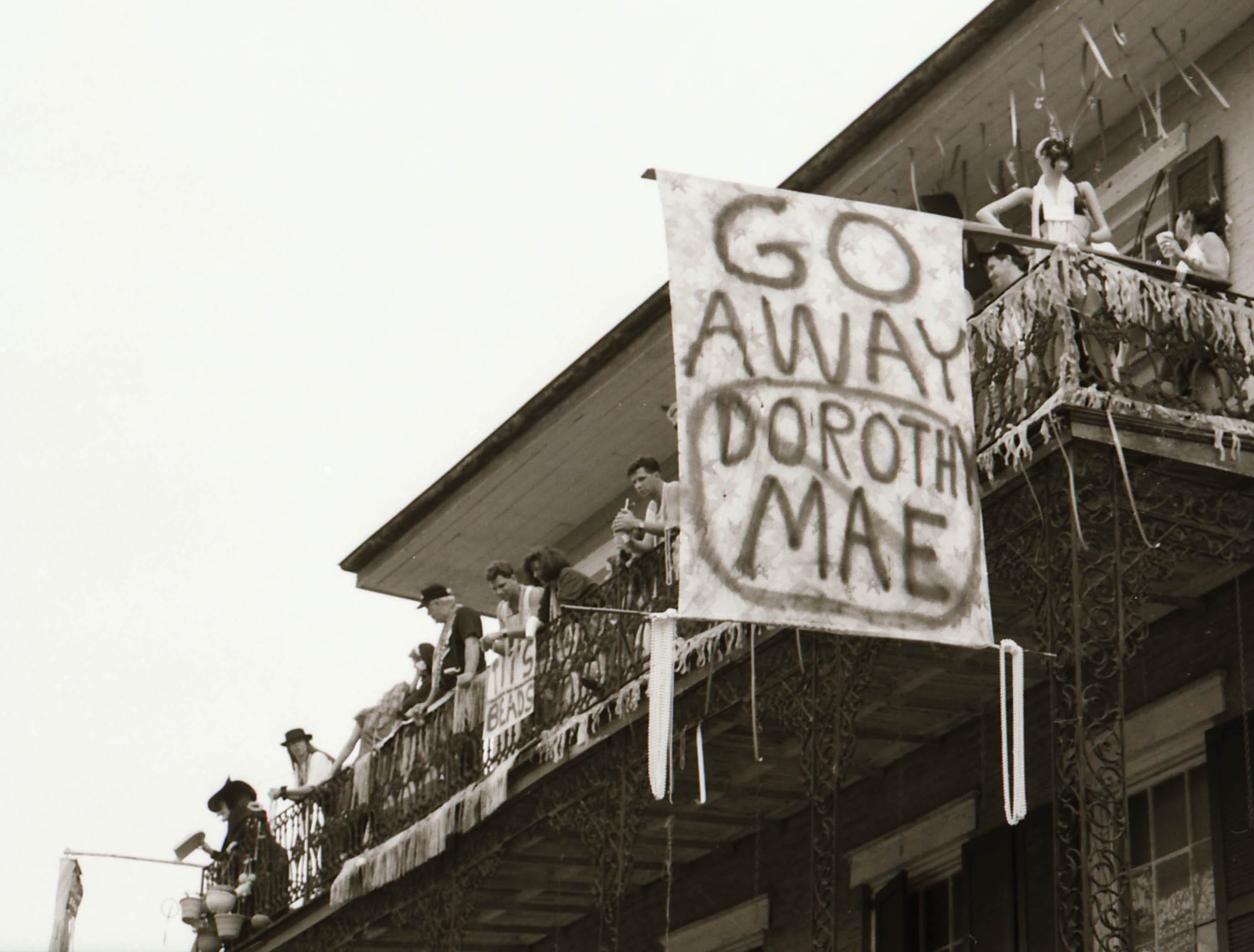
It was also the year Councilmember Dorothy Mae Taylor pushed through an ordinance requiring krewes parading on public streets to open their ranks.
The backlash was immediate. Some old-line krewes chose to stop parading rather than integrate, clinging to exclusivity as if widening the street might shatter tradition.
Before Michael. Before Julian. Before that reckoning, I had been blissfully ignorant of Mardi Gras’ long history of exclusion.
One night, over drinks, a friend said Dorothy Mae had “ruined Mardi Gras.”
Julian didn’t blink. “Ruined it how?”
“She’s destroying tradition.”
“Tradition?” he shot back. “God forbid a Black man ride in Rex.”
The bar went quiet. I rushed to soften it, to insist she didn’t mean it that way. What began as a debate about parades turned into something more personal between Julian and me — about what I was willing to see and what I was still protecting.
I believed the ordinance was right. I told myself that meant I understood.
It didn’t.
Understanding is not something you catch like a doubloon tossed your way. It requires stepping off the platform and asking why you were standing there in the first place.
Weeks later, Julian and I walked into Treme before dawn on Mardi Gras morning. Fully masked, we were neither Black nor white — just two people moving anonymously through the crowd.
For once, the glances dissolved.
Mardi Gras became sanctuary.
We laughed hysterically as a Zulu rider held up a sign, “Yell… if you want me to ride in Rex next year.”
When Julian caught my first Zulu coconut, it felt less like something handed down from above and more like something shared at eye level.
Dorothy Mae hadn’t ruined Mardi Gras after all. She widened it.
The street made room.
And so did I.
This year, I didn’t do Mardi Gras.
A family obligation kept me away, something tender and necessary, and I told myself I would be fine missing it. Mardi Gras has lived in me long enough that I don’t need to stand on St. Charles or beneath the Claiborne overpass to feel it.
But of course, I looked.
I opened social media the way you crack a door, just to peek at what you’re missing. I scrolled through brass bands, coconuts, glittering children, Indians radiant in sunlight — and then I saw what I wish I hadn’t.
A Black doll hanging in a bead noose.
Riders targeting protest signs, turning mockery into sport.
Images of white men in orange prison suits dancing.
And something in me sank — not because Mardi Gras has never held ugliness; this city has always been a place of contradictions — but because the ugliness felt less hidden, less embarrassed, as if something in the air had given it permission to step beyond the mask and into the open.
As if they mistook their corner of the street for the whole city.
Because I have spent my life behind a camera, I know how light behaves. It finds the cracks. And there is not enough orange makeup, Botox, or spin to conceal what’s behind the mask.
We in New Orleans understand that every spell fades with the morning light, and that ashes are never far behind.
Sooner or later, the mask comes off. The crown slips. The cheering fades. The platform is dismantled board by board.
And the mirror does what mirrors do.
yep - so many ways to experience Mardi Gras , life , and eternal darkness
Another fantastic essay full of essential truth. Our downtown Mardi Gras was magical this year, and we did miss you and Mark on the Bend in the aftermath.